

Musing about Odysseus
On the Odyssey

Greetings,
As you can see from the title, I’ve been thinking about The Odyssey. Not that I’ve been reading them. Instead, I’ve been reading about the Trojan War, so I got the wrong Homeric poem (The Iliad). I’m one of those weirdoes who think that the Trojan War did happen. Probably not exactly as Homer recounted it, but I’m sure it happened. The evidence is there if you know where to look.
Similarly, I’m sure the Odyssey of Odysseus (try saying that three times as fast) did happen. I’m sure we know the story, but I’ll recount them for the sake of the readers…
After the Greeks ransacked Troy (thanks to the ingenious plan of hiding in a “trojan horse”), King Odysseus of Ithaca made ready to return home back to his kingdom with his army. But through a series of unfortunate events, he ended up in various places and encountered perils from cannibal giants to the cyclops to sea monsters. And throughout this journey, Odysseus slowly loses his crew and ships. Meanwhile back in Ithaca, his wife Penelope is flooded by suitors eager to win the hand-in-marriage of the presumably widowed Queen. And these suitors were rude and acted like they owned the place, even mistreating Telemachus, the son of Odysseus and Penelope. But eventually, Odysseus made his way home—after 20 years of absence—just in time to mass murder Penelope’s suitors and reclaim his home.
I always wondered where Odysseus might have been taken in that journey. I wasn’t the only one, since I found this cool looking map showing where the places that Odysseus and his crew went to might have been after his Mycenaean buddies ransacked Troy.
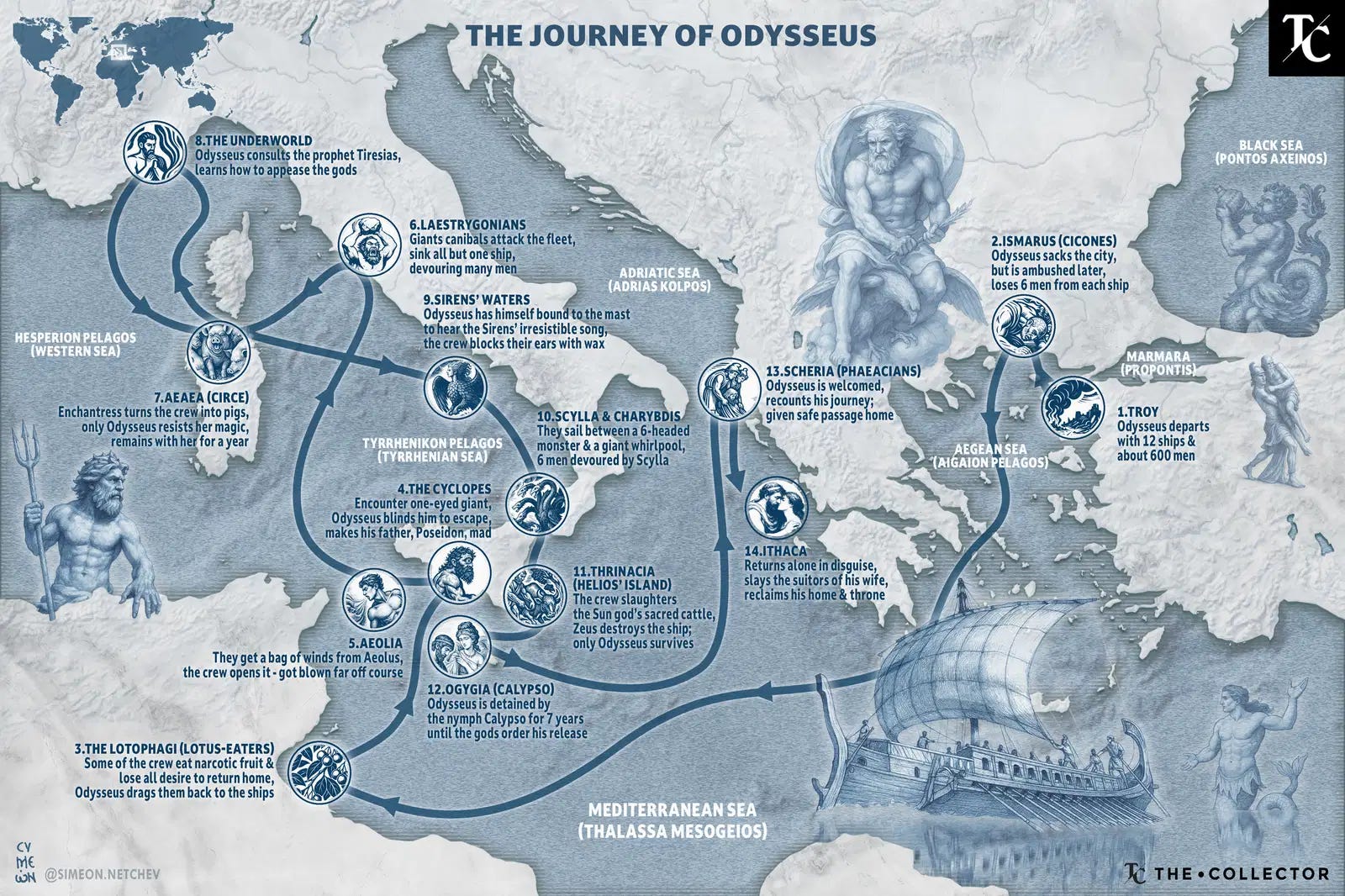
As I have said before, I do believe that the Odyssey of Odysseus did happen. I’m sure there was a military leader or king who took part in a historical Trojan War who on his voyage home was blown off course and took some time before he finally returned back home.
Now did this journey home involve cannibal giants or a horny goddess? Probably not. But there’s no reason to discount an actual “Odyssey”, a misadventure of a group of pirates who got lost on their way back home.
So here’s my take on the “historical Odyssey”. Of course, it’s just my take. My take is as good as anyone else’s.
The Historical Odyssey
Odysseus and his crew departed after ransacking Troy. On their way home, they got lost and ended up various places all over the Mediterranean. Now what I found striking, at least in detective mode, was how there were literally no witnesses to this great journey other than Odysseus himself (as far as mortal beings go).
Supposedly, Odysseus departed from Troy with 12 ships and about 600 men. Well then, where were they? They were all killed by Zeus, you say? Well how convenient was it that when Odysseus was recounting his journey, there was no else left alive who could have contradicted him? Anything could have actually happened out there for all we know. But dead men tell no tales, as the saying goes.
And then there was the whole Calypso episode. I mean, Odysseus was “detained” by a super hot goddess who wants to make him immortal. But somehow Odysseus wasn’t happy with the arrangement. And we were supposed to believe that he was forced to lie with her every night against his will. This went on for seven years, which was longer than 66% of marriages that involve Kim Kardashian.

And yet we’re supposed to believe that Odysseus was detained in this marriage until Zeus finally put a stop to it. Yeah… sure, Odysseus, sure.
More likely, Odysseus had a falling out with Calypso (after seven years, seven years!). And so he left, and with his tails between his legs (all his men were long dead… somehow), and finally returned back home to Ithica.
Odysseus returned home just in time to find his wife about to get married (I mean, 20 years is a long time; in most countries today, Odysseus would be considered legally dead). Naturally, he didn’t like it, so he killed everyone. Hence the slaughter of the suitors, which Telemachus with no love lost for “mama’s boyfriends” was all to willing to take part in also.
The End.
Is it a cynical look on the story of Odysseus? Sure. But not entirely unreasonable. I always find it interesting how the poet Dante Alighieri put Ulysses (the Latin version of Odysseus) in hell.
And while Dante’s account of Ulysses’ death was different to how The Odyssey actually unfolded, I don’t think Dante was very far off when it comes to the character of Odysseus. Nor was Dante’s version of Ulysses’ death all that different to the Greek versions; in all these cases, Odysseus ultimately died a violent death (including one that was Oedipus-esque, let’s just say).
Clearly, Odysseus was not an admirable figure. None of the Greek heroes were, except for maybe Perseus.
And I didn’t even get to Circe, the other side piece of Odysseus.
But hey, that’s just a theory.

Until next time,
Michael P. Marpaung
Much of the Odyssey is narrated by Odysseus in situations in which it's clear he's lying somewhat, or has just lied. So even if we take Homer's poem as literal truth, we do not need to believe he did most of the things claimed. The poem itself is designed to allow us to take as cynical a view as we wish, pretty much other than his mass-killing of the suitors.